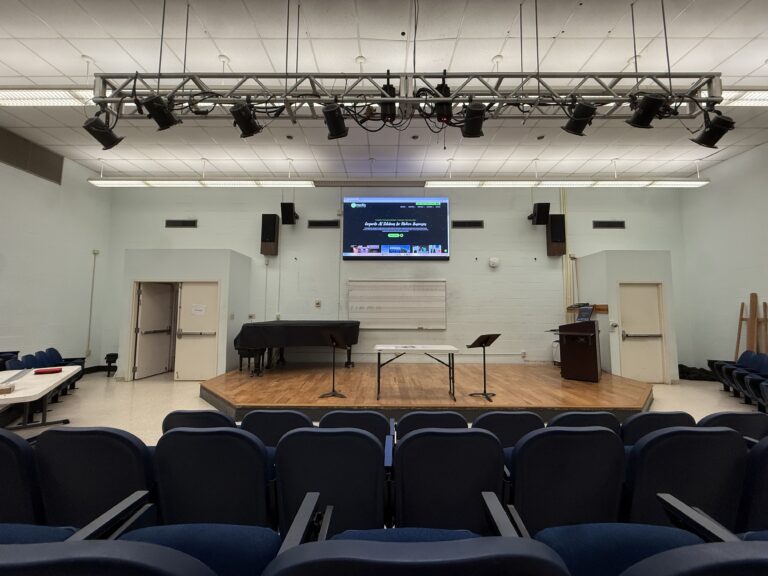

Commercial audiovisual technology is doing more with less equipment than ever before. And for those of us who love this industry, it’s pretty exciting to watch.
There was a time when adding a feature to an AV system usually meant adding another piece of equipment.
Need to switch between video sources? That’s a box. Scale an image to fit a display? Another box. Audio processing, echo cancellation, system control? More boxes.
Before long, you had an equipment rack full of hardware, each component performing its own specialized task.
Today, there’s a pretty good chance that many of those capabilities are already built into a single device. And we think that’s pretty incredible.
At Go Media, we’ve spent more than two decades designing and installing professional audiovisual systems for businesses, schools, and government agencies across Louisiana and Texas. We’ve watched the technology evolve from racks full of dedicated components to remarkably capable, compact devices that can accomplish things we once needed an entire system to do. We’re passionate about this industry, and we love seeing that progression.
The short answer: Commercial AV is shifting work that once required dedicated hardware (switching, scaling, audio processing, echo cancellation, and control) into software running on fewer, more powerful devices and across the network. Systems need less equipment and less cabling than they used to. But the room, the acoustics, and the people using the space still matter just as much, so thoughtful system design matters more than ever.
In This Article
- From Equipment Racks to Single Devices
- When Hardware Becomes Software
- The Easy Button Isn’t Always That Easy
- Fewer Boxes Still Need Good Design
- More Possibilities, Better Solutions
- And Then There’s AI…
- Frequently Asked Questions
- It’s a Great Time to Be in AV
From Equipment Racks to Single Devices
To appreciate how far commercial AV has come, it helps to look at what used to take a dedicated piece of hardware and where that same job often lives today.
| Function | Then | Now |
|---|---|---|
| Video switching | A dedicated matrix switcher in the rack | Built into presentation switchers, displays, and conferencing devices, or handled over the network with AV-over-IP |
| Image scaling | A standalone scaler for each display | Built into modern displays and video endpoints |
| Audio processing & echo cancellation | Rack-mounted digital signal processors | Built into video bars and conferencing appliances, or run on networked audio processors |
| Microphones | Rows of wired gooseneck and table microphones | Ceiling and table beamforming arrays that steer toward whoever is talking |
| Room control | A control processor plus custom programming for every function | Still essential for complex rooms; simpler rooms often use the platform’s own touch controller |
| Signal distribution | Point-to-point cabling between every device | Audio and video carried across standard network infrastructure |
None of those older approaches were wrong. They were the best tools available at the time. But the trend is clear: more capability is being packed into fewer, smarter devices.
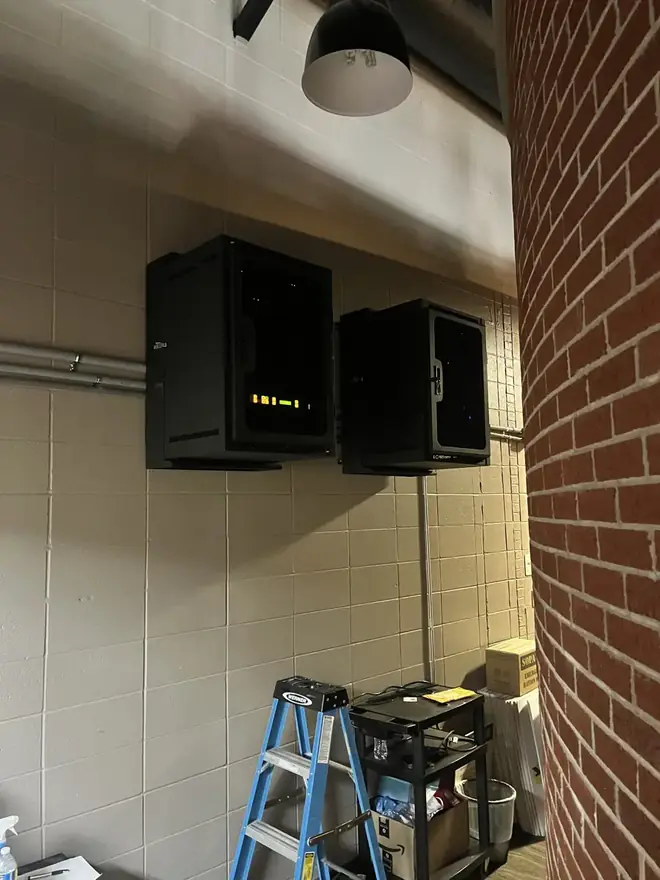
When Hardware Becomes Software
One of the biggest changes in commercial AV isn’t necessarily what systems can do. It’s how they do it.
Functions that once required dedicated hardware are increasingly handled by software running on powerful processors.
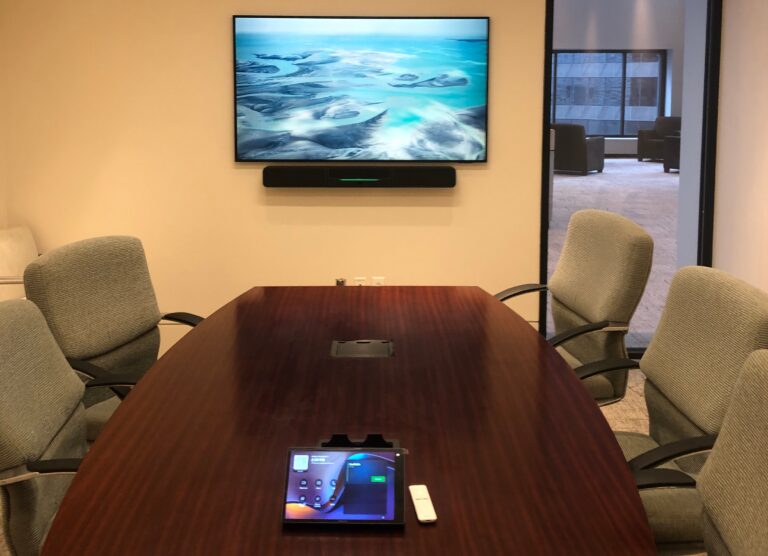
Consider a modern video conferencing appliance. A single device might incorporate cameras, microphones, speakers, acoustic echo cancellation, automatic camera framing, and the conferencing platform itself. That’s an extraordinary amount of functionality packed into something that can fit beneath a display, and it’s a big reason Teams and Zoom rooms have become so accessible. (If you’re weighing your options there, our guide to Microsoft Teams Rooms vs. BYOD walks through the differences.)
The same evolution is happening throughout the industry:
- Audio processors can automatically manage microphones and optimize sound.
- Network-based systems can distribute audio and video throughout a facility without relying on traditional point-to-point switching architectures.
- Displays have built-in processing and connectivity that would have seemed downright luxurious not so long ago.
- Wireless presentation systems let people share content without hunting for the right cable.
And manufacturers keep finding new ways to combine capabilities. The result is that we can often design systems with fewer physical components, less cabling, and greater functionality.
Of course, fewer boxes doesn’t always mean less complexity.
The Easy Button Isn’t Always That Easy
If you’ve spent any time looking at modern AV equipment, you’ve probably noticed a recurring theme in the marketing:
Plug it in. Press a button. Everything just works.
And sometimes, it really is that simple! Manufacturers deserve credit for making sophisticated technology more accessible and easier to operate.
But the real world has a habit of complicating things.
- A conferencing system might have an excellent built-in microphone array, but that doesn’t mean it will perform equally well in a small meeting room and a large boardroom with glass walls. (Room acoustics have a lot to say about that.)
- A camera might offer automatic speaker tracking, but its effectiveness still depends on where it’s installed and how the room is used.
- A product advertised as an all-in-one solution might do ten things exceptionally well while falling short on the one feature that’s most important to a particular customer.
That’s not a criticism of the technology. It’s simply the reality of designing systems for spaces occupied by actual people, rather than the ideal conditions of a product demonstration.
The technology keeps getting smarter. The laws of physics haven’t changed.
Good system design still matters, even when the equipment makes everything look easy.
Fewer Boxes Still Need Good Design: What to Plan For
When a system leans on software and the network instead of a rack full of hardware, the planning conversation shifts. Here’s what we look at on today’s projects:
- The network. Networked audio, video, and control depend on the right switches, bandwidth, and configuration. We coordinate with your IT team early so AV traffic and security policies work together.
- The room itself. Microphone coverage, speaker placement, sight lines, lighting, and acoustics determine whether an all-in-one device is enough or whether the room needs a more complete audio and video design.
- How people will actually use it. The best systems are intuitive for the person who walks in five minutes before a meeting. A well-designed AV control system keeps even sophisticated rooms simple to operate.
- Software, licensing, and updates. Software-driven equipment receives firmware updates and new features over time, and some platforms carry subscriptions. Those belong in the plan from day one, along with who will manage them.
- Room to grow. Choosing platforms that can scale protects your investment. Our article on AV system lifespan and when to upgrade covers how to think about that long-term.
It’s also worth noting that fewer components don’t automatically mean a smaller budget. Capable integrated devices, network infrastructure, and the design and programming time behind them all factor in. If you’re planning ahead, our breakdown of what a commercial AV system costs in 2027 offers realistic ranges by room type.
More Possibilities, Better Solutions
One thing we particularly enjoy about the evolution of AV technology is the flexibility it gives us.
Sometimes a customer needs a straightforward conference room that just works. A thoughtfully selected integrated solution might accomplish everything they need without an elaborate equipment rack or unnecessary complexity.
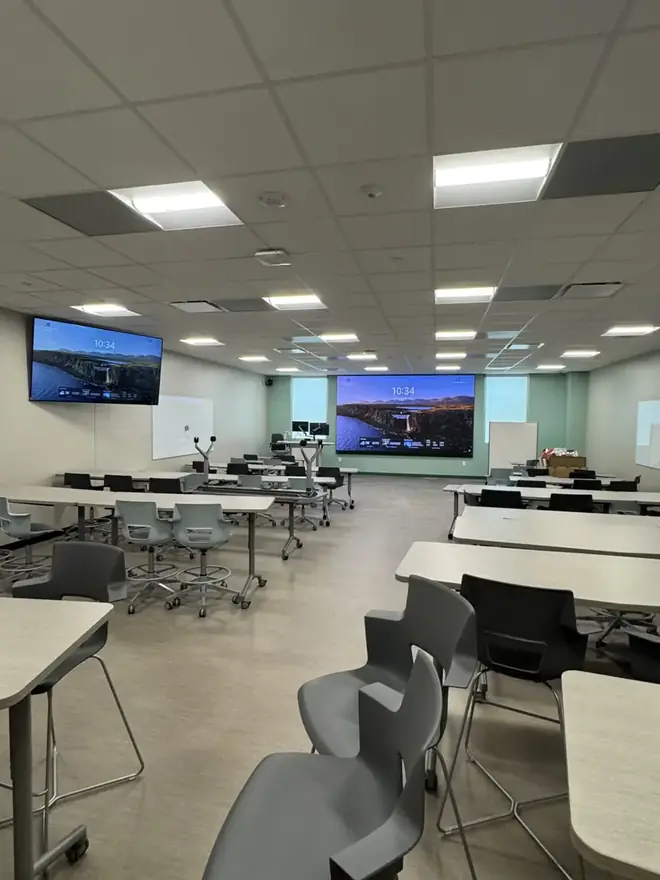
Other projects call for something much more sophisticated. A divisible meeting space, auditorium, council chamber, or emergency operations center might require specialized equipment and carefully coordinated systems.
Take a recent council chamber project in Carencro. The clerk’s station brings microphone management and room control onto a single workstation and touch panel, while the supporting equipment lives in compact wall-mounted enclosures rather than a dedicated equipment room. It’s a great example of modern technology simplifying a space that still has demanding requirements, and the kind of work we do for local governments across Acadiana and beyond.
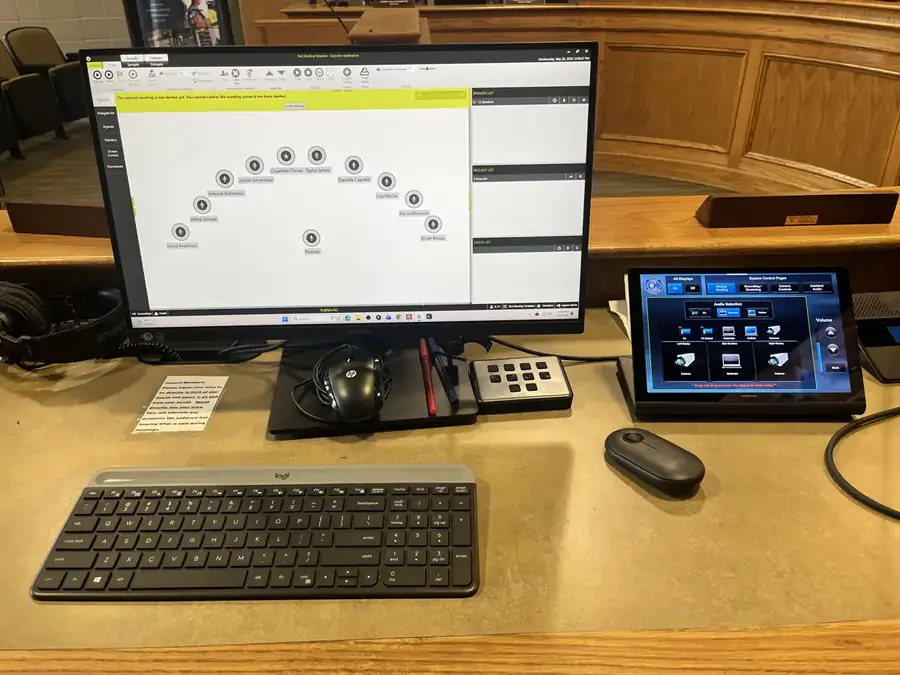
Neither the simple approach nor the sophisticated one is inherently better. The fun part is figuring out what makes the most sense for the application.
And with more manufacturers, technologies, and system architectures available than ever before, there are some pretty creative ways to solve problems.
At Go Media, we’re not particularly attached to doing things the way they’ve always been done. If new technology lets us deliver a better experience for a customer, we’re all for it. But we’re equally comfortable recognizing when a proven, more traditional approach is the right answer.
The goal isn’t to install the newest technology.
It’s to use the best technology for the job.
And Then There’s AI…
It’s hard to talk about the future of technology without mentioning artificial intelligence.
Interestingly, commercial AV has been incorporating forms of intelligent automation for years. Automatic camera tracking, beamforming microphone arrays, adaptive audio processing, and automated room controls all allow systems to respond to changing conditions without someone constantly adjusting settings.
Not all of these technologies are technically artificial intelligence. Many rely on conventional signal processing and automation. But they’ve been moving us toward more responsive, intuitive systems for a long time.
Now, newer AI capabilities are opening up some fascinating possibilities. Could future AV systems understand conversational instructions, help configure themselves, diagnose their own problems, or automatically adapt to how a room is being used?
We think there’s tremendous potential there. Exactly how AI will reshape commercial AV remains to be seen, and it’s a subject we plan to explore in a future article. For now, we’re excited to see where it goes.
Frequently Asked Questions About Modern Commercial AV
How has commercial AV technology changed?
Functions that once required separate pieces of hardware, like video switching, scaling, audio processing, echo cancellation, and control, are increasingly built into fewer, more capable devices or handled in software and across the network. Modern systems typically use less equipment and cabling while offering more features.
Can an all-in-one video bar handle a large conference room?
Sometimes, but not always. All-in-one devices work well in the rooms they’re designed for, usually huddle spaces and small to medium meeting rooms. Larger rooms, glass-walled spaces, and rooms with challenging acoustics often need additional microphones, speakers, or audio processing to perform well.
What is AV-over-IP?
AV-over-IP sends audio and video signals across standard network infrastructure instead of dedicated point-to-point cabling and switchers. It makes it easier to route content anywhere in a facility and to expand a system later, but it requires the right network design and coordination with your IT team.
Does less hardware mean a cheaper AV system?
Not necessarily. Integrated devices can reduce the number of components and the amount of cabling, but capable equipment, network infrastructure, licensing, and professional design and programming still factor into the overall cost. The right system is the one that fits how the room will actually be used.
Is AI already part of commercial AV systems?
Forms of intelligent automation, such as automatic camera framing, beamforming microphones, and adaptive audio processing, have been part of commercial AV for years. Newer AI capabilities, like conversational control and self-diagnosing systems, are emerging, and we expect them to play a growing role.
It’s a Great Time to Be in AV
After more than twenty years in this business, you’d think we might have seen just about everything. Not even close.
The technology keeps surprising us. Things that were complicated and expensive just a few years ago are becoming increasingly accessible, and new capabilities are creating opportunities we wouldn’t have imagined when we started. That’s a big part of why we love what we do.
At Go Media, we get to combine that enthusiasm for technology with the experience to know how to put it to work. Whether that means a simple, elegant solution or a highly sophisticated system, we’re always looking for better ways to serve our customers. You can see how we approach every project on our process page, or browse recent installations in our portfolio.
Planning a new space or wondering whether your current system could do more with less? Talk to an expert at Go Media. We’d love to help you find the right fit.
Less hardware. More intelligence. More possibilities.
We can’t wait to see what’s next.