

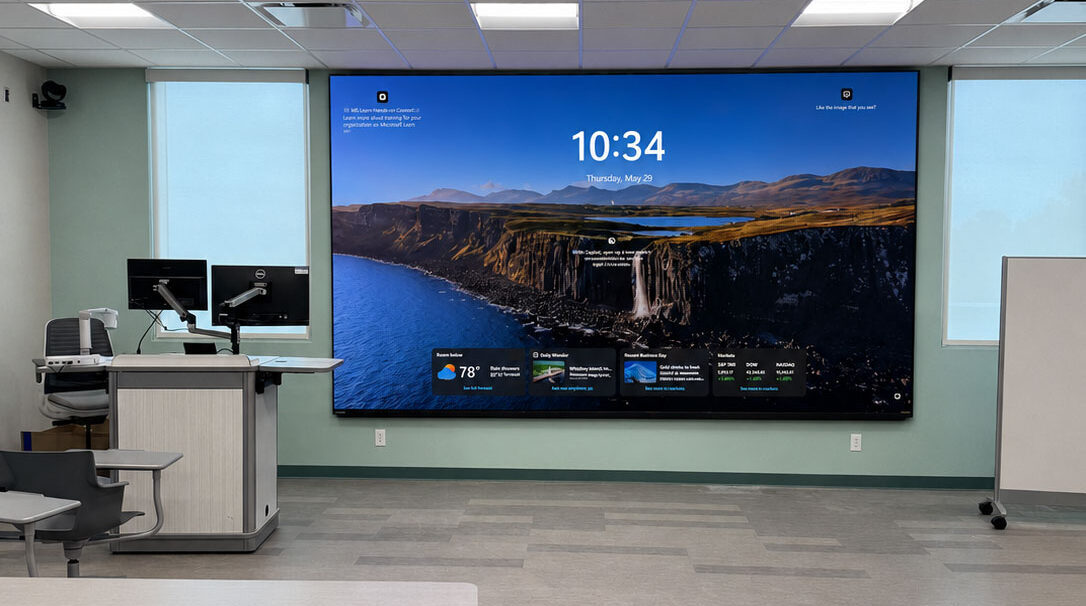
Direct View LED video walls, often called DVLED video walls, have become one of the most popular display technologies for corporate spaces, higher education, K-12 schools, houses of worship, command centers, retail environments, and public venues.
But if you’ve started comparing DVLED products, you’ve probably realized that not all LED walls are created equal. Pixel pitch, brightness, LED technology, processing, serviceability, and long-term support can have a significant impact on both performance and cost.
This guide covers the key specifications and considerations buyers should understand before investing in a DVLED video wall.
Pixel Pitch: The Most Important Specification
Pixel pitch measures the distance between LED pixels in millimeters. Generally speaking, a smaller pixel pitch creates a sharper image and allows viewers to sit closer to the screen.
Common indoor pixel pitches include:
- 2.5mm for larger viewing distances
- 1.8mm to 1.5mm for conference rooms, classrooms, and lobbies
- 1.2mm and below for premium fine-pitch applications
One important fact many buyers don’t realize:
Every time you cut the pixel pitch in half, you roughly quadruple the number of LEDs required to fill the same area.
For example, a 1.2mm wall contains approximately four times as many pixels as a 2.4mm wall of the same size. More LEDs, tighter manufacturing tolerances, additional processing requirements, and increased complexity all contribute to higher costs.
The goal isn’t necessarily to buy the smallest pixel pitch available. It’s to choose the right pitch for the viewing distance and application.
If you are still comparing display types, our article on Direct View LED vs. TV video walls can help you understand the differences between traditional video wall displays and DVLED technology.
Brightness
Brightness is measured in nits and should always be evaluated based on the environment.
Many buyers assume higher brightness is automatically better, but that’s not always the case. In conference rooms, classrooms, command centers, and houses of worship, excessive brightness can become distracting or uncomfortable during extended viewing.
Factors to consider include:
- Ambient light levels
- Window exposure
- Viewing duration
- Indoor vs. outdoor use
- Automatic brightness adjustment capabilities
A properly designed DVLED wall should be bright enough to perform in the space without overwhelming the audience.
SMD vs. COB Technology
Two of the most common LED technologies are SMD, or Surface-Mounted Device, and COB, or Chip-on-Board.
SMD remains the most widely deployed DVLED technology and offers an excellent balance of performance, cost, and serviceability.
COB technology provides additional durability and protection while becoming increasingly popular in fine-pitch applications and high-traffic environments.
Neither technology is automatically better. The right choice depends on the application, budget, and maintenance requirements.
For a deeper dive, check out our article: SMD vs. COB LED Walls: What’s the Difference and Why Does Pricing Vary?
Refresh Rate and Image Quality
While pixel pitch receives most of the attention, image quality depends on much more than resolution alone.
Refresh rate, grayscale performance, color accuracy, contrast, and image processing all contribute to the final viewing experience.
This becomes especially important in:
- Houses of worship
- Broadcast environments
- Boardrooms
- Auditoriums
- Livestreaming applications
A quality DVLED solution should perform just as well on camera as it does in person.
Serviceability Matters
A DVLED wall is a long-term investment, and eventually every system will require maintenance.
Before selecting a product, buyers should understand:
- Front-service vs. rear-service access
- Availability of replacement modules
- Manufacturer support policies
- Spare parts availability
- Warranty coverage
A lower purchase price can become expensive if replacement parts are difficult to obtain years down the road.
Because DVLED is a long-term investment, it is also helpful to understand how long AV systems last and when aging technology should be evaluated for replacement or refresh.
Not All LED Manufacturers Are Equal
The DVLED market has expanded rapidly over the last several years. Along with established manufacturers, many private-label, rebranded, and lesser-known products have entered the market.
While some of these solutions can be attractive from a pricing standpoint, buyers should carefully consider long-term support.
Questions worth asking include:
- Will replacement modules still be available in five years?
- Does the manufacturer have a proven support structure?
- Are firmware updates readily available?
- Is there a clear warranty process?
- Does the integrator have experience servicing the product?
The lowest-cost option isn’t always the lowest-cost ownership experience.
That doesn’t mean every lesser-known product should be avoided. It simply means buyers should evaluate the long-term stability of both the manufacturer and the support network behind the product.
DVLED Is More Than a Flat Wall
One of the most exciting developments in DVLED technology is the variety of form factors now available.
In addition to traditional video walls, today’s solutions can include:
- Curved LED walls
- Convex and concave designs
- Free-standing LED posters
- Transparent LED displays
- Architectural LED features
- Custom-shaped installations
- Indoor and outdoor digital signage solutions
For exterior applications, Go Media also provides outdoor LED solutions for businesses, venues, and organizations that need durable, high-visibility digital displays.
Whether the goal is a statement piece in a corporate lobby, an immersive worship environment, a command center display, or a unique customer experience, modern DVLED technology offers far more flexibility than many buyers realize.
At Go Media, we help customers evaluate both traditional and creative LED applications to find the right balance between visual impact, performance, and budget.
Seeing Is Believing
Specifications can tell part of the story, but nothing replaces seeing a DVLED wall in person.
Pixel pitch, brightness, image processing, cabinet quality, and LED technology all become much easier to evaluate when viewed side-by-side. What looks similar on a spec sheet can look dramatically different in the real world.
That’s why Go Media maintains showroom displays that allow customers to experience multiple DVLED technologies firsthand. Comparing solutions in person often provides more clarity than hours of online research.
You can also explore our audio-visual project portfolio to see examples of how custom display, video wall, and AV solutions are used in real spaces.
If you’re considering a DVLED project, contact our team to schedule a showroom visit. We’ll help you compare options, understand the tradeoffs, and identify the solution that best fits your space, goals, and budget.